

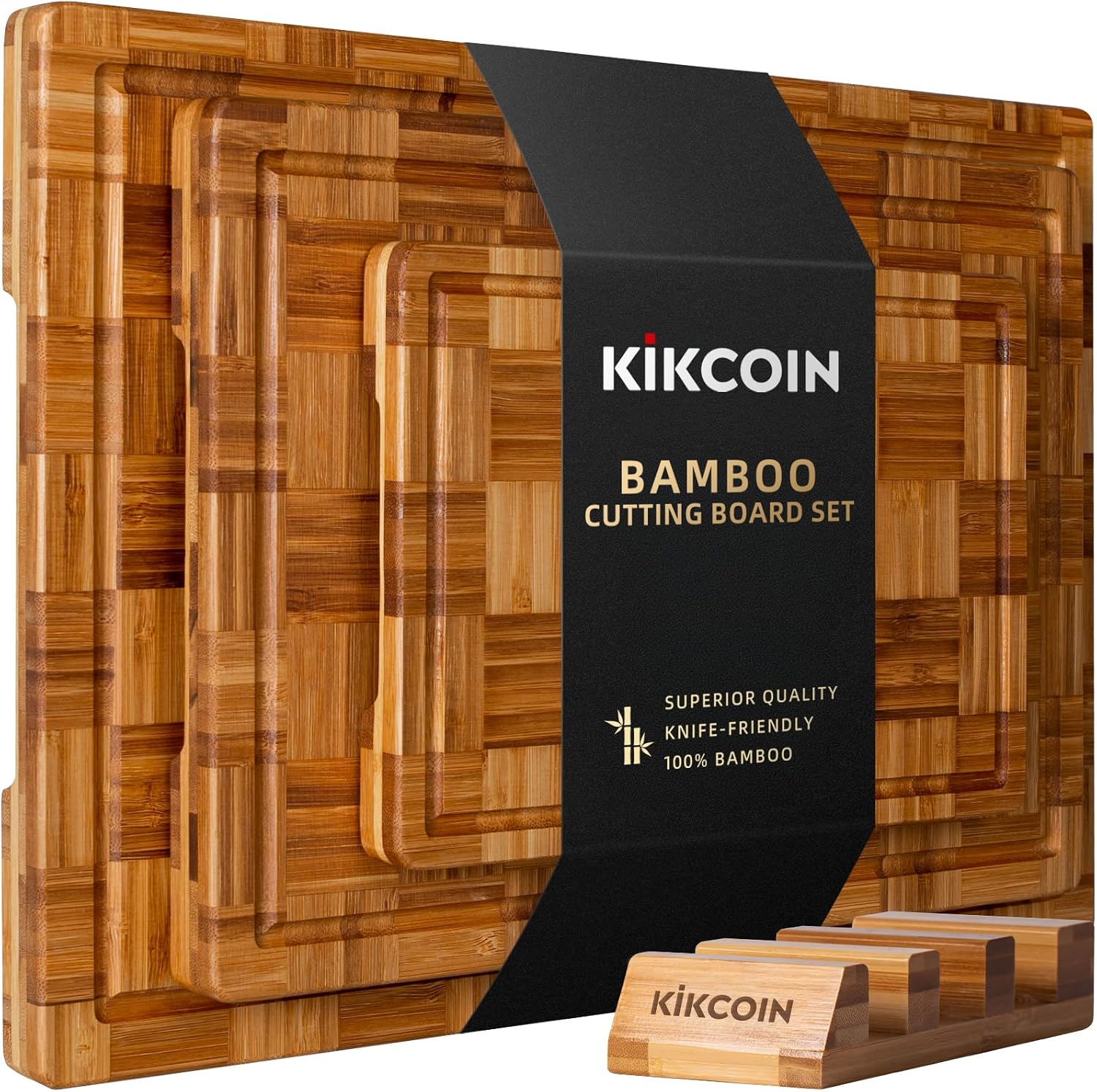
Kikcoin Extra Large Bamboo Cutting Boards Review: Are Bamboo Boards Really Worth It?
A cutting board is the most used tool in most kitchens, and also one of the least thought about. Material, size, and how you clean it all affect how long it lasts and how safe your food prep is. The Kikcoin Extra Large Bamboo Cutting Boards come as a set of three with juice grooves and handles. In this review we look at what research says about bamboo, wood, and plastic boards, what this specific set offers, and who it suits. You can check the current price on Amazon.
Is a Bamboo Board Better Than Wood or Plastic?
Short answer: it is a good, practical choice, but not a magic one.
Most of the claims you see on bamboo board listings (antibacterial, knife friendly, super durable) come from marketing rather than from independent testing. The most useful research is about cutting boards in general, so that is where we start.
A well known body of work from the UC Davis food safety lab compared wooden and plastic boards in conditions designed to look like a home kitchen. Its main findings:
- Bacteria such as E. coli O157:H7 and Salmonella were hard to recover from wooden boards shortly after being applied. The bacteria were still alive inside the wood for a while, but they did not multiply and gradually died.
- New plastic boards were easy to clean and disinfect. Plastic boards covered in knife scars were much harder to clean by hand, especially with food residue like chicken fat.
- Used wooden boards with many knife cuts behaved almost like new wood.
A 1992 case-control study in northern California, often cited alongside this work, found that people who used wooden boards were less than half as likely to get salmonellosis as people who used plastic or glass boards.
Some caveats matter here:
- This evidence is about wood, not bamboo specifically. Bamboo is a grass, and bamboo boards are made from pressed strips, so we cannot assume it behaves exactly like solid hardwood.
- The author of the UC Davis work notes that other labs have reported different results. The science here is not settled, and these studies are older.
- Food safety agencies treat both wood and plastic as acceptable. Extension guidance from the University of California says either material can be used for raw meat and poultry, as long as you clean it well and replace it when it is worn out.
Why Your Cutting Board Matters More Than You Think
A cutting board is where raw food and ready-to-eat food are most likely to meet. Raw meat, poultry, and seafood can carry bacteria that cooking kills, but if you slice salad vegetables or bread on the same unwashed surface afterward, those bacteria go straight to food that will not be cooked again. That is cross-contamination, and it is one of the most common causes of foodborne illness at home.
Extension guidance recommends two simple habits:
- Use one board for fresh produce and bread, and a different board for raw meat, poultry, and seafood.
- Wash boards with hot, soapy water after each use, rinse, and let them dry completely.
This is where a set of three sizes is genuinely useful. It makes it easier to keep raw and ready-to-eat foods apart without washing in the middle of every recipe.
What About Plastic Boards and Microplastics?
One reason people are moving away from plastic is a 2023 study in Environmental Science & Technology. Researchers found that chopping on plastic boards releases tiny plastic particles, and they estimated that a regular user could be exposed to millions of microplastic particles per year from this source. The health effects of these particles are not yet well understood, and the study does not prove harm. It is a reason to be curious about alternatives, not a reason to panic.
Bamboo and wood boards do not shed plastic, though they have their own trade-offs, which we cover below.
What Is Bamboo, and How Is a Bamboo Board Made?
Bamboo is technically a grass, not a tree. It grows quickly and can be harvested in a few years, which is why it is often called a sustainable material. That benefit is real, but it is partly offset by processing, shipping, and the adhesives used to make the board.
A bamboo cutting board is made from strips of bamboo that are pressed and glued into thick layers. A few facts worth knowing:
- Hardness: Traditional laminated bamboo is in the same range as common hardwoods. Flooring tests put it at roughly 1,180 to 1,380 on the Janka hardness scale, compared with about 1,290 for red oak and 1,450 for hard maple. Harder boards last longer against scratches, but they are also less forgiving on knife edges than softer woods.
- Adhesives: Many laminated bamboo products use urea-formaldehyde adhesives, and standards limit how much formaldehyde they may release. We could not confirm which adhesive Kikcoin uses. If that matters to you, check the product listing or ask the seller.
- Finish: The Kikcoin set is described as finished with food-safe mineral oil.
What the Kikcoin Set Offers
The set includes three boards in different sizes, so you can match the board to the job:
- Extra large (17 x 12 inches): For roasts, whole chickens, melons, and big prep sessions.
- Large (14 x 10 inches): Everyday vegetables, meat, and bread.
- Medium (10 x 7 inches): Herbs, garlic, fruit, and small tasks.
Other features include:
- Deep juice grooves: Channels on the board catch runoff from raw meat, tomatoes, or melon so it stays off your counter.
- Built-in handles: Easier to carry, hang, or store.
- Reversible design: You can flip the boards, and the smaller ones work as serving trays.
- Thick layered bamboo: Built to resist cracking and warping.
- Non-slip feet on the larger boards: Helps keep them from sliding while you chop.
Buyers commonly mention that the boards feel sturdy, stay flat, and do not splinter after months of regular use.
A Note on the "Naturally Antibacterial" Claim
Bamboo boards are often described as naturally antibacterial. The best evidence we have is about solid wood, where bacteria that soak in tend to die over time rather than multiply. We did not find strong independent testing showing the same for laminated bamboo boards. So treat this claim as unproven. A bamboo board is not self-cleaning, and it still needs proper washing, especially after raw meat.
Quick Pros & Cons
Pros:
- Three sizes in one set, so raw and ready-to-eat foods are easier to keep apart.
- Deep juice grooves keep counters clean.
- Thick layered construction resists warping and cracking.
- Handles make the boards easy to move and store.
- Reversible, and the smaller boards work as serving boards.
- Does not shed plastic particles like plastic boards can.
- Good value for a three-piece set.


Cons:
- Hand wash only. Laminated boards can crack or split in the dishwasher.
- Needs occasional oiling to stay in good shape.
- Bamboo is on the harder side, so it is less gentle on knife edges than softer woods.
- Can absorb strong smells if you do not clean it soon after use.
- The adhesive details are not clear, so check the listing if that matters to you.
- The largest board takes real storage space.
Who Should Buy It (And Who Can Skip It)
It makes sense if you:
- Cook often and want to keep raw meat and produce on separate boards.
- Prep big meals or batch cook and need a large surface.
- Want to cut down on plastic in the kitchen.
- Do not mind washing by hand and oiling a board now and then.
You can probably skip it if you:
- Want to put everything in the dishwasher.
- Prefer softer wood boards, which are gentler on expensive knives.
- Have very little counter or cabinet space.
How to Care for Bamboo Boards
- Wash with hot, soapy water after each use, rinse, and dry fully. Do not soak the board.
- Stand it upright or flat in the air so both sides dry.
- Once in a while, sanitize it by covering the surface with a solution of 1 tablespoon of unscented liquid chlorine bleach per gallon of water. Leave it for a few minutes, rinse, and dry.
- Rub in food-grade mineral oil when the surface looks pale or dry. A light coat every few weeks is usually enough with regular use.
- After cutting onions, garlic, or fish, wash the board soon so smells do not set in.
- Replace any board that is badly worn or has deep grooves that are hard to clean, since these can hold bacteria.
Frequently Asked Questions
Are bamboo cutting boards safe for raw meat? Yes, if you wash them well with hot soapy water and keep a separate board for raw meat and one for ready-to-eat food.
Can I put bamboo cutting boards in the dishwasher? No. Laminated boards can crack or split in the dishwasher, so wash by hand.
Are bamboo boards better than wood boards? Not clearly. Bamboo is a fast-growing material and it is hard-wearing, but the best food safety research is on wood, and bamboo is harder on knife edges.
Do bamboo boards dull knives? Harder materials wear a knife edge faster than softer ones. Bamboo is in the harder range, so keep your knives sharpened and honed regularly.
How often should I oil a bamboo board? When it starts to look dry or pale. For regular use, a light coat of food-grade mineral oil every few weeks is a good rule of thumb.
How long do bamboo cutting boards last? With hand washing and occasional oiling, they can last for years. Replace them when they develop deep cuts that are hard to clean.
Final Verdict
The Kikcoin Extra Large Bamboo Cutting Boards are a practical, good-value set for anyone who cooks regularly. The three sizes make it easy to separate raw and ready-to-eat foods, the juice grooves keep the counter clean, and bamboo avoids the plastic shedding that comes with plastic boards. It is not antibacterial by magic, it needs hand washing, and it is a bit tougher on knives than softer woods. Treat it like any good kitchen tool, clean it properly, and it should serve you well. Prices change often, so check the latest deal on Amazon before you buy.
This article is for general information. For specific food safety questions, follow guidance from your local food safety authority.
Sources
- UC Davis, Plastic and wooden cutting boards study. https://commonsensehome.com/wp-content/uploads/2024/11/PLASTIC-AND-WOODEN-CUTTING-BOARDS-UC-DAVIS-STUDY.pdf
- University of California Cooperative Extension, Cutting Boards: Food Safety. https://ucanr.edu/sites/MFPOC/Food_Safety/Cutting_Boards_-_Food_Safety
- Cutting Boards: An Overlooked Source of Microplastics in Human Food? Environmental Science & Technology, 2023. https://pubmed.ncbi.nlm.nih.gov/37220346/
- Bamboo floor (hardness and adhesives overview). https://en.wikipedia.org/wiki/Bamboo_floor