

Etekcity Digital Kitchen Scale Review (EKS-C193-KUS): Accurate Food Weighing for Baking, Meal Prep and Weight Loss Goals
Most home cooks measure with cups and spoons, and most people eyeball portions on their plate. Both habits are less precise than we think. A digital kitchen scale replaces guesswork with a number, and that is why it has become a staple for bakers, meal preppers, and anyone trying to eat more mindfully. The Etekcity Digital Kitchen Scale (Medium, Midnight Black) is one of the best-known budget options on Amazon. This review covers what it measures, how to use it, what research says about weighing food and weight loss, and where it falls short. You can check the current price on Amazon.
Why This Scale Keeps Showing Up at the Top
The listing shows a 4.6 out of 5 rating from 178,055 ratings, an Amazon's Choice badge, and more than 1,000 bought in the past month. It also ranks #1 in Digital Kitchen Scales and #7 in the wider Kitchen & Dining category. At $14.99 in Midnight Black (other colors appear on the listing between $13.99 and $17.99), it sits at the low end of the price range for digital scales. Popularity does not guarantee quality, so we focus below on the specs and what they mean in daily use.
The Numbers on the Spec Sheet
| Feature | Details |
|---|---|
| Brand and model | Etekcity, EKS-C193-KUS |
| Maximum weight | 5,000 g (176 oz, 11 lbs) |
| Minimum weight | 2 g |
| Increments | 1 g |
| Units | g, oz, lb:oz, ml (milk and water), fl oz (milk and water) |
| Display | Backlit LCD |
| Platform | Non-slip |
| Power | 2 x AAA batteries (pre-installed) |
| Auto-off | After 3 minutes |
| Form factor | Mini counter scale |
| Warranty | 2 years |
| In the box | Scale, quick start guide, 2 AAA batteries |
Reading the Display: Buttons, Units and Tare
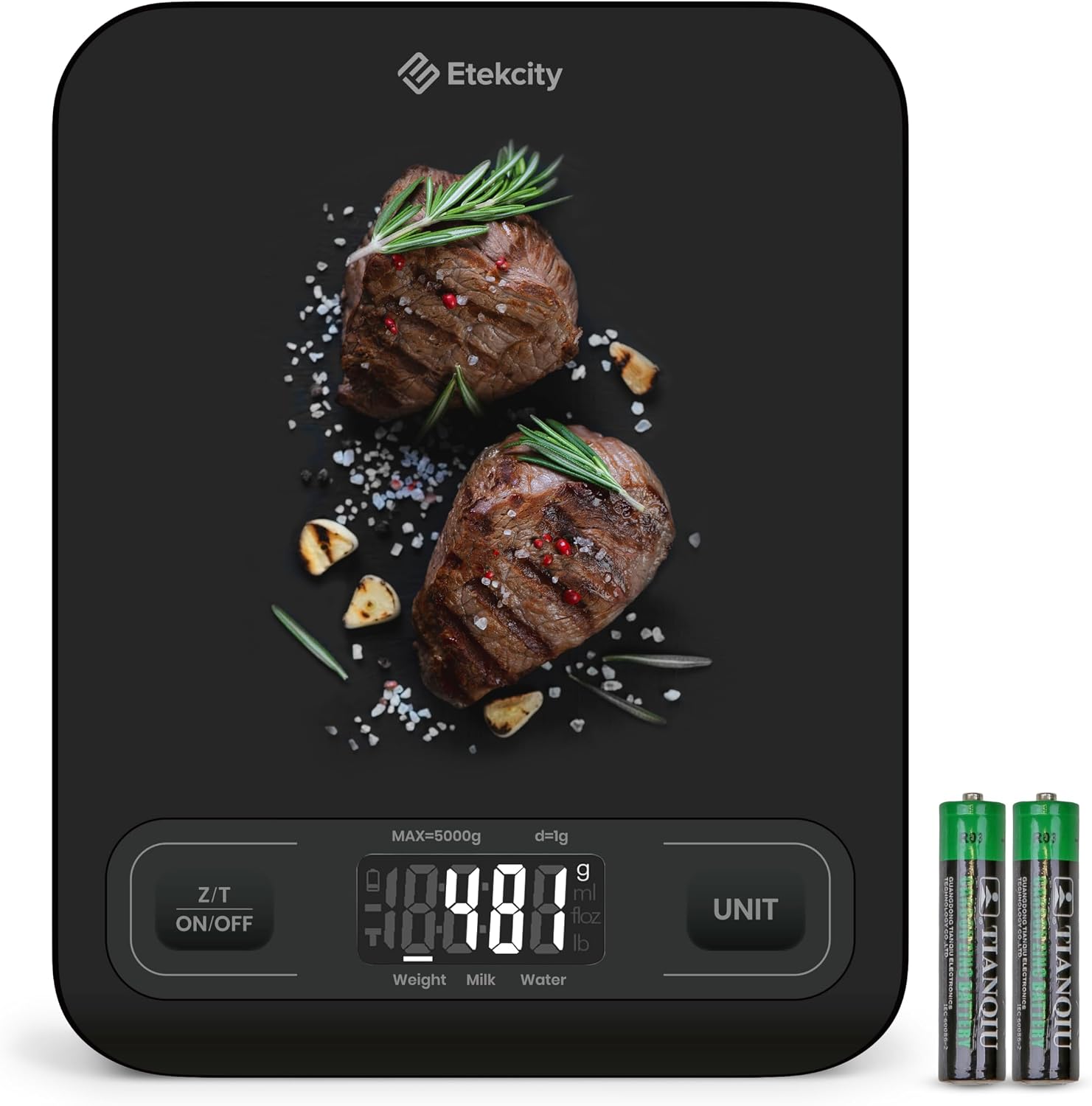
In our photo, the scale has just two buttons, Z/T ON/OFF and UNIT, beside a clear digital display that also labels weight, milk, and water modes. Here is the basic routine:
- Press Z/T ON/OFF to turn the scale on.
- Place an empty bowl or container on the platform.
- Press Z/T again to zero the scale. This is the tare function, and it means the weight of the bowl is ignored.
- Add your ingredient and read the weight.
- Tare again and add the next ingredient. This "add and tare" method lets you measure several ingredients into one bowl, with fewer dishes to wash.
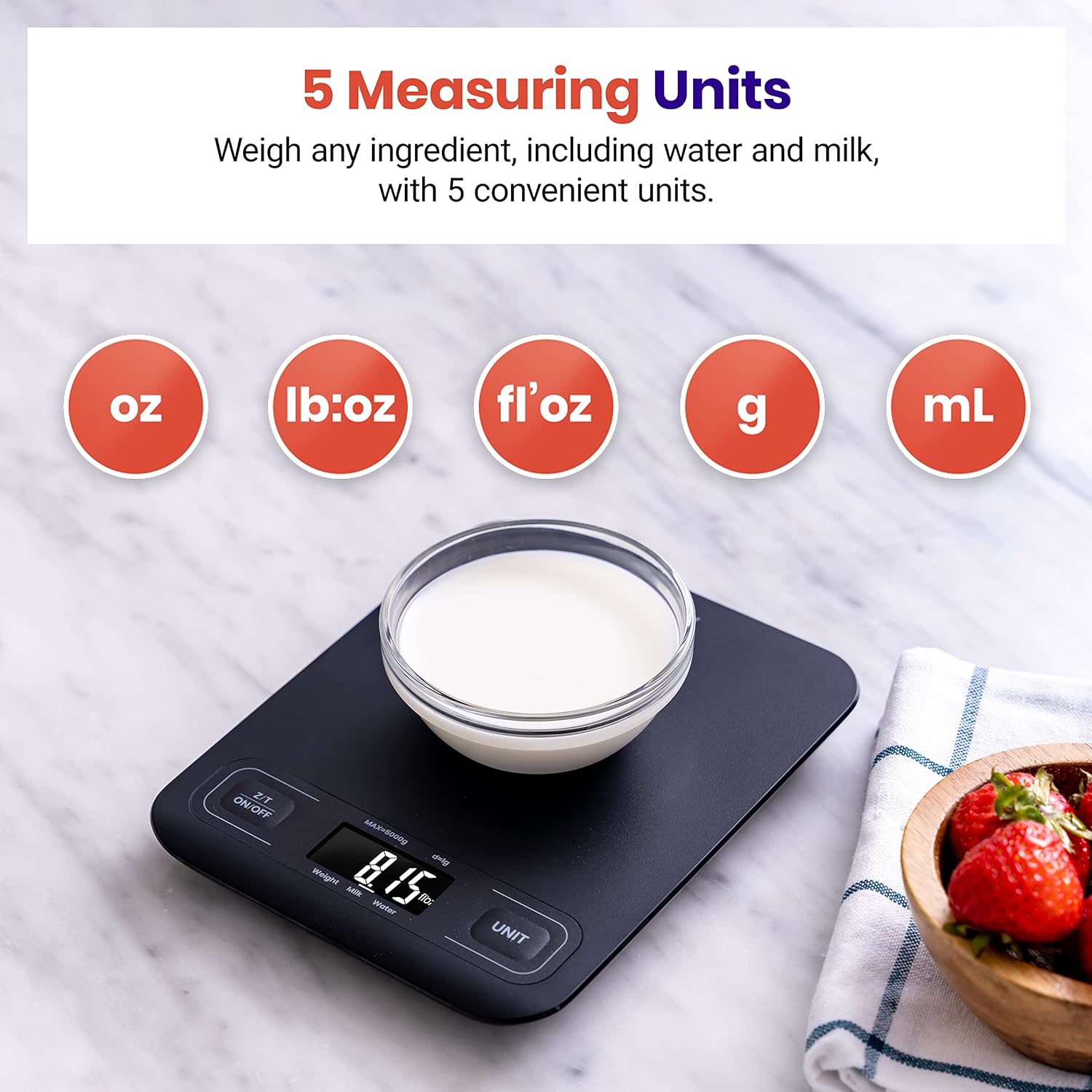
- Press UNIT to cycle through grams, ounces, pounds and ounces, and milliliters or fluid ounces for milk and water.
The milliliter and fluid ounce modes only work for milk and water. For other liquids such as oil or honey, use grams, since their density is different.
Why Grams Beat Measuring Cups
Baking is chemistry, and a cup is not a precise unit. A test published by The Cupcake Project found that a cup of all-purpose flour weighed 128 grams on average, but the result changed with how the flour was scooped. Dipping the cup into the bag averaged 139 grams, while spooning the flour in averaged 128 grams. Across all tests the weights ranged from 124 to 144 grams, a 20 gram spread. In the author's bread test, that 20 gram difference noticeably changed how the loaf rose.
A scale removes this problem. Weighing flour, sugar, and butter in grams gives the same result every time, makes it easy to scale recipes up or down, and lets you follow metric recipes without conversions.
Kitchen Scales and Weight Loss: What the Research Says
No kitchen tool makes you lose weight on its own. What a scale does is give you accurate information, and the research suggests that tracking what you eat matters.
Self-monitoring and weight loss. A systematic review of 22 studies published between 1993 and 2009 found a consistent, significant association between self-monitoring and weight loss. Fifteen of those studies focused on keeping a food journal, and both written and electronic journals helped. The review has important limits, though. Many of the studies had methodological weaknesses, most participants were white women, and most data were self-reported. It shows an association, not proof that tracking causes weight loss.
We are not good at judging portions. A study that tested how well people estimate portion sizes found that, on average, participants underestimated portions by about 10%, with large differences between individuals. Some foods were underestimated far more: beverages by 30% to 46%, pasta by about 32%, and pizza by about 44%. Some calorie-dense foods such as cheese, croissants, and peanuts were overestimated. The authors note that their sample was small, lean, and mostly white, so the results may not apply to everyone.
Put together, these findings suggest a sensible use for a scale. It gives you an objective number for foods that are easy to misjudge, and it supports the habit of logging what you eat. It does not tell you how much you should eat. That depends on your body, health, and goals, and is best discussed with a doctor or registered dietitian.
Practical Ways to Use a Scale for Healthier Eating
- Weigh your containers once and tare them. Zero the scale with your plate or bowl on it, then add food.
- Pick one unit and stick to it. Grams are the easiest for consistent tracking.
- Check whether a food's label refers to raw or cooked weight. Rice, pasta, and meat can change weight a lot when cooked, so weigh them the same way the label or app entry describes. Labels vary, so check each one.
- Start with foods that are hard to eyeball, such as pasta, rice, nut butters, cheese, and drinks.
- Write it down. The research links journaling, not just weighing, with better outcomes. Pair the scale with a notebook or an app.
- Aim for consistency, not perfection. A rough log you keep is better than a perfect one you abandon.
When a Food Scale May Not Be the Right Tool
Weighing every meal is not helpful for everyone. If counting grams makes you anxious, or if you have a history of disordered eating, talk to a healthcare professional before using a scale for portion tracking. The same goes if you are pregnant, managing a medical condition, or planning weight loss for a child. This article is general information, not medical advice.
What 1 Gram Increments Really Mean
The listing states an accuracy of 1 g, a minimum weight of 2 g, and a maximum of 5,000 g. That is fine for flour, rice, meat, vegetables, and most everyday cooking. It is less ideal for very small amounts. Because the display rounds to whole grams, a 5 gram portion of salt, yeast, or spice could be off by up to half a gram, which is about 10% of the amount. For a 100 gram portion, the same half-gram is only 0.5%. If you often weigh tiny quantities, a scale with 0.1 g increments is a better match.
The "1 g" in the listing describes the display step, not a guarantee of laboratory accuracy. To check any scale, weigh an object of known weight, such as a calibration weight or a coin whose official weight you can look up.
Batteries, Auto-Off and Care
The scale runs on two AAA batteries, which come pre-installed. The listing warns against mixing new and used batteries, so replace both at once. Auto-off kicks in after 3 minutes, which saves battery life, but it can interrupt a slow recipe, so press Z/T to wake it and re-tare if needed. Wipe the platform with a slightly damp cloth, avoid submerging it in water, and keep it on a flat, hard surface for the most reliable readings.
What We Like, What We'd Change
What we like:
- Clear, backlit LCD display that is easy to read.
- 5,000 g (11 lb) capacity covers most home cooking.
- Tare function and an "add and tare" workflow.
- Several units, including milliliters and fluid ounces for milk and water.
- Non-slip platform keeps bowls in place.
- Compact mini size fits in small kitchens and drawers.
- Batteries included, plus a 2 year warranty.
- Very low price for the rating and review volume.

What we'd change:
- 1 g increments are too coarse for tiny quantities.
- Minimum weight of 2 g.
- Auto-off after 3 minutes can interrupt slow prep.
- Milliliter and fluid ounce modes work only for milk and water.
- Runs on AAA batteries, with no USB charging.
- It weighs food but does not count calories or connect to an app.
- Platform size and dimensions are not listed, so check large bowls before buying.
Is $14.99 a Fair Deal?
For a scale with a 4.6 rating from more than 178,000 ratings, a 2 year warranty, and batteries included, the price is hard to argue with. Prices vary by color and change often, so check the current listing. You do not need an expensive model unless you want features such as 0.1 g precision, a USB rechargeable battery, or built-in nutrition tracking.
Who Will Use It Daily
It makes sense if you:
- Bake bread, cakes, or pastries and want consistent results.
- Meal prep and portion food into containers.
- Want better awareness of portion sizes while working toward a health goal.
- Follow low-carb, keto, or other plans that involve weighing food.
- Need a simple, low-cost scale for packages or small shipments.
You may want a different scale if you:
- Weigh very small quantities, such as spices, yeast, or saffron.
- Want built-in calorie or macro tracking.
- Need to weigh jewelry or precious items where tiny differences matter.
- Work with very large bowls or trays that need a bigger platform.
Common Questions About the Etekcity Scale
Does it have a tare function? Yes. The Z/T button zeros the scale, so you can ignore the weight of a bowl or plate.
What units does it use? Grams, ounces, pounds and ounces, and milliliters or fluid ounces for milk and water.
What is the maximum weight? 5,000 grams, which is 176 ounces or 11 pounds.
How precise is it? It reads in 1 gram steps.
Does it need batteries? Yes, two AAA batteries, which are pre-installed.
Does it turn off by itself? Yes, after 3 minutes.
Will it help me lose weight? It can help you measure portions and track what you eat, which research associates with weight loss. Results depend on your overall eating habits, activity, and health.
Does it count calories? No. It measures weight only. You need a food label or an app to convert weight to calories.
Is there a warranty? The specs list a 2 year warranty.
Wrapping Up
The Etekcity Digital Kitchen Scale is a simple, affordable tool that does one job well: it tells you exactly how much something weighs. It is useful for bakers who want repeatable results and for anyone who wants a more accurate view of portion sizes. It is not a diet plan, and it will not replace advice from a health professional. Its 1 gram steps, AAA batteries, and short auto-off timer are small trade-offs at this price. If you want a reliable everyday kitchen scale without spending much, it is an easy recommendation. Prices change often, so check the latest deal on Amazon before you buy.
This article is for general information and is not medical or nutrition advice. Talk to a qualified professional about your own health and weight goals.